Self-prepared
Ticket and read ahead
You tell yourself the tale
- TicketIDR 150,000 adult
- Stage gate16:00
- ShowStarts 18:00, ends 19:00
Party total, worked out
Weigh up 4 options
Set your party size and the tour totals update.
≈
View≈
View≈
View≈
ViewLowest GetYourGuide prices, converted with the ECB reference rate; checkout shows the final total.
The Kecak dance story is a short stretch of the Ramayana: an exile, an abduction, a monkey envoy and a burning palace. Know the cast and the order before you sit down, and the hour at Uluwatu makes sense from the first chant.
Editorial team, kecakfiredanceuluwatu.com · Updated November 2, 2026 · Roughly 6 min to read
The essentials up top
What is the Kecak dance? A sung drama carried by a male chorus.3 In the Ramayana Kecak dance at Uluwatu, Prince Rama and his wife Shinta are sent into exile in the forest. Rahwana, the demon king, carries Shinta off, and the white monkey warrior Hanoman becomes central to her rescue.1 The Ministry of Tourism tells it with Rama wandering into the woods beside Shinta and his brother Lakshmana; the giant Rahwana seizes Shinta there and keeps her inside his palace.5
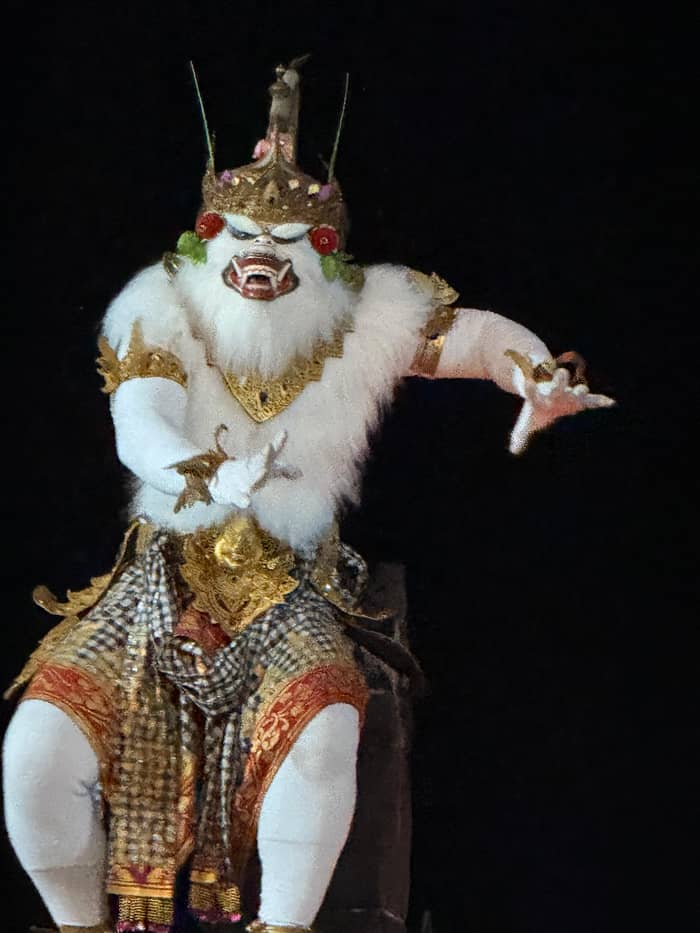
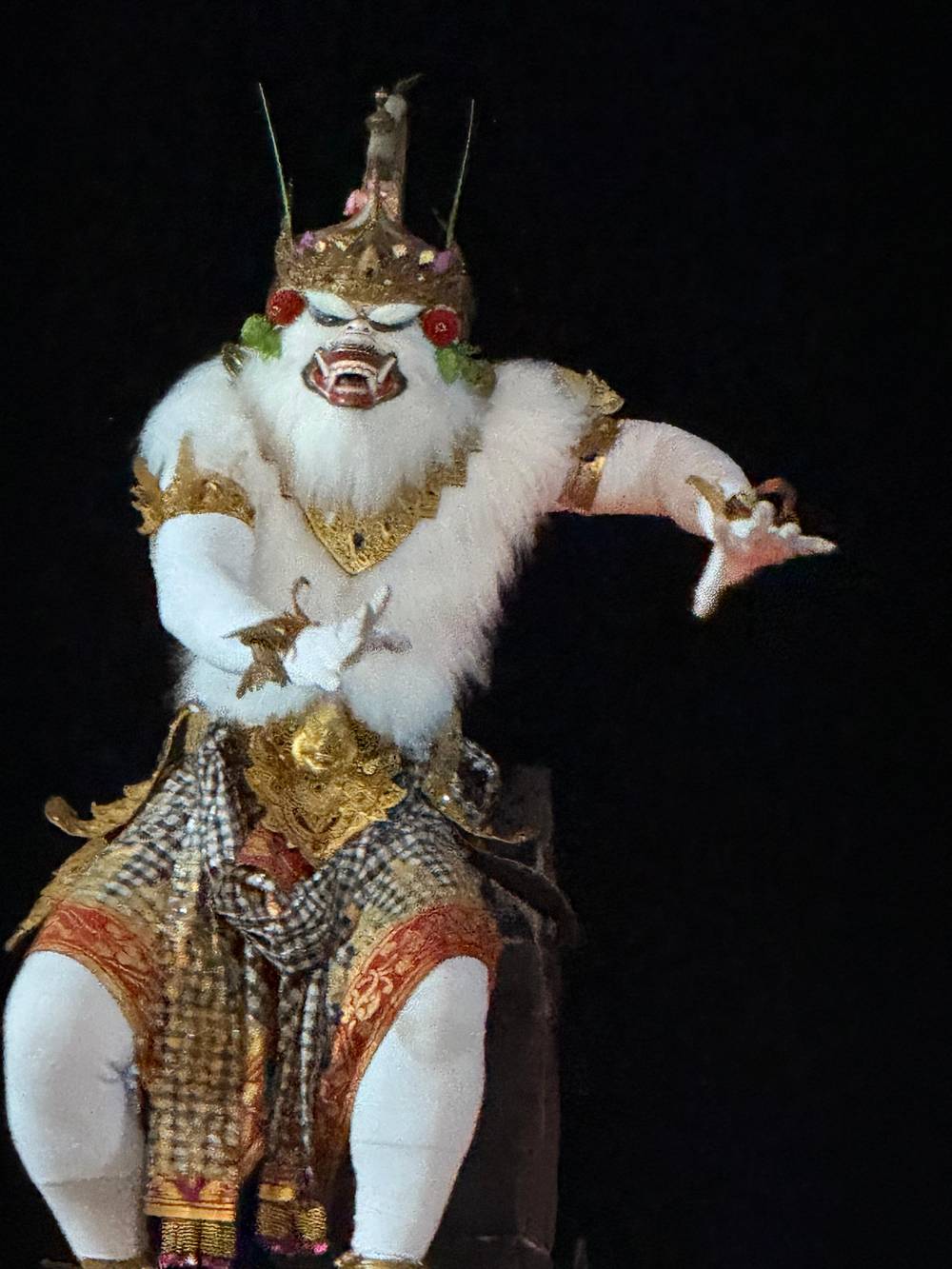
Rama then seeks help. The monkey king Sugriwa dispatches his commander, the white monkey Hanoman, to look in on Shinta at Rahwana's palace.6 Rahwana's soldiers take Hanoman and set him in a ring of fire; he comes out unhurt and sets the palace alight instead.7 The temple's own telling also ends the show there, with the fire as the climax.2
The war follows in the Ministry's version. Rama is overrun at the start by Rahwana's troops, until Sugriwa and Hanoman arrive with the monkey army and the evil king is beaten.8 The temple summarizes the meaning in one line: a battle between good and evil.9 You do not need to know every detail of the epic to follow it.10 In the Ministry's wording the Kecak shows the episode of Sita's kidnapping by Ravana and Rama's fight, helped by Hanoman and the monkeys; Sita and Ravana are the Sanskrit forms of Shinta and Rahwana.11
Scene by scene
| Scene | The action | Who carries it |
|---|---|---|
| The exile | Rama, Shinta and Lakshmana walk into the woods | Rama and his wife |
| Shinta taken | Rahwana seizes Shinta and keeps her inside his palace | Rahwana |
| The envoy | The monkey king Sugriwa sends Hanoman to find her | Hanoman |
| The flames | Hanoman is put in a circle of fire and burns the palace | Hanoman and the circle |
| The final fight | The monkey troops help Rama and defeat the evil king | The ring of men |
The order follows the Ministry of Tourism's retelling; the temple's own telling ends with the fire dance.5,6,7,8,2
The performance has four core characters: Rama the central hero, Shinta his wife, Rahwana the abductor and Hanoman the white monkey warrior who helps Rama.15 The Ministry of Tourism adds Lakshmana, Rama's brother, and Sugriwa, the king of the monkeys, to the story.5,6 That is the entire list you need before the lights go down. A statue of Kumbakarna, another warrior of the Ramayana, stands inside the temple precinct, so the epic is present on the cliff well before the show begins.16
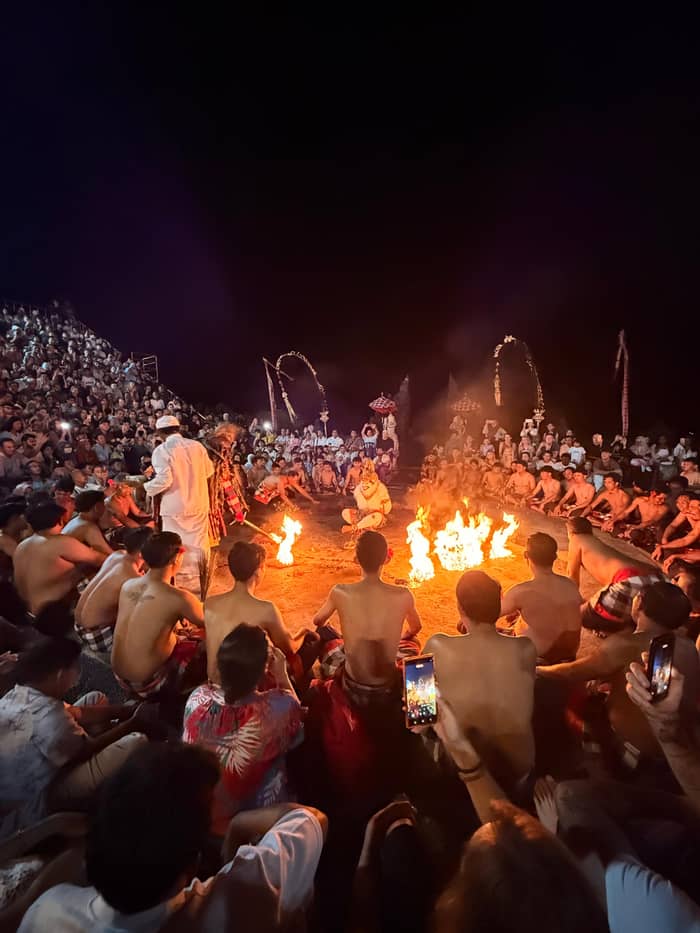
The circle is a second cast. The Ministry pictures rings of some 50 to 60 men, bare-chested in Balinese sarongs, seated cross-legged around a cluster of torches.17 A soloist leads the chorus, indicates the high and low notes and acts as narrator.18 The chorus itself represents an army of monkeys.19
So the audience watches two performances at once, the story told by the central characters and the collective chanting of the circle.20 Let your eyes move between them. When the circle raises its arms and changes its vocal patterns, something is about to happen in the middle.21
The evening with its hours
16:00
The management lists the Kecak gate opening at 16:00.4
Seated before 17:00
The Ministry of Tourism asks for arrival before 17:00 WITA for a seat and the sunset.12
18:00
The show begins at 18:00 and closes at 19:00 each day.4
In the dusk
The rhythm may grow stronger and more dramatic as the tension rises.13
When the torches burn
The fire scene comes near one of the dramatic high points of the story.14
19:00
The daily showtime ends at 19:00.4
Other Balinese performances are usually accompanied by the gamelan orchestra. The Kecak is carried by people. Instead of that orchestra, the chorus chants cak in polyrhythmic sounds during almost the entire performance.25 The temple's management puts it in a line: no musical instruments, only a large male chorus producing the famous cak-cak-cak.3
Seated cross-legged, the chorus lifts its hands and sways its bodies in time with the cak, as the Ministry describes it.26 The rhythm is not a fixed loop. At Uluwatu it may grow stronger and more dramatic as the tension builds in the story.13
Balinese tradition holds that the cak sound chases off evil spirits and carries protective power.27 That belief explains why the chanting feels more like a ritual than like background music, and why a seated audience goes quiet around it. Even a first-time viewer feels the shift when a whole amphitheater stops talking at once.
What to watch
The show moves quickly, so choose what you want to catch.
If I want the story
Learn the four main names
Rama, Shinta, Rahwana and Hanoman are the core characters.15
If I want the sound
Watch the soloist
A soloist leads the chorus and acts as narrator.18
If I want the fire
Stay for the fire's dark half
The fire scene comes near a high point of the story, after dusk.14,22
If I plan to film it
Skip the flash
Flash disrupts the performers and other spectators.23
If My evening is tight
Arrive by 17:00
6:00 PM is the show time, and arriving at 6:00 PM is already too late.12,24
Three ways to take it in
Self-prepared
You tell yourself the tale
Guided
A guide at the north gate
Ride from the hotel
Temple, show, Jimbaran Bay
The Uluwatu management dates the Kecak to the 1930s, a joint creation of the Balinese artist Wayan Limbak and the German painter Walter Spies.35 The Ministry dates its first appearance to 1930, when Limbak worked with Spies to build a dramatic version of the Sanghyang with the Ramayana in it.36
The Sanghyang is the older, sacred dance. Its model was the sacred Sanghyang dance, performed against negative spirits, which was reshaped into a story dance drawn from the Ramayana.37 The Ministry adds that the pair adapted the ritual and added drama from the epic to attract foreign tourists.38
The stage version has long since become local property. The Ministry of Tourism notes that the Kecak began as a show for tourists yet has grown into an essential piece of Bali's cultural identity.39 The Ministry page adds that art schools and cultural studios still teach its movements to the younger generation.40 A dance born as a stage piece now sits close to the center of how Bali presents itself.
The fire is the scene that draws the cameras, and the Ministry of Tourism calls the moment Hanoman sets fire to Ravana's kingdom the most mesmerizing one.41 The management offers a reading: the fire is thought to purify and protect, and the ring of chanting men stands for unity and protection.9
The scene does not arrive at random. By the management's account the fire scene arrives once the conflict is built, close to a dramatic high point.14 By then the audience knows who Rahwana is, why Shinta is gone and what Hanoman has come to do.
Seen that way, the fire is an answer. Hanoman survives the circle of fire and burns the palace that held Shinta.7 The performance climaxes there, in the temple's account, symbolizing the triumph of good over evil.2
Video
CLO on YouTube · YouTube is contacted only once you press play.
The performers raise their arms, change their vocal patterns, react to dramatic moments, and help create the emotional rhythm of each scene.
Checklist
There is no spoken dialogue to follow. The Ministry says the story is conveyed through facial expressions, movements and rhythmic sounds, and the character dancers use hand gestures, facial expressions and graceful steps.42,43 Costumes and the reaction of the chorus help visitors follow without understanding every element.44
The audience has jobs too. The management asks visitors to respect designated seating, keep voices low, avoid flash photography and not walk around during the performance.31,33,23,32 Big backpacks and luggage may be refused in the seating area, and the amphitheater bans smoking.45,46
Up to 1,200 spectators fit in the amphitheater for each show, on stone seating that calls for comfortable footwear.47,30 Drones are not allowed.48 Bring a light cushion of patience, and let the story reach you in its own time. Once the chanting starts, there is nothing to do but listen.
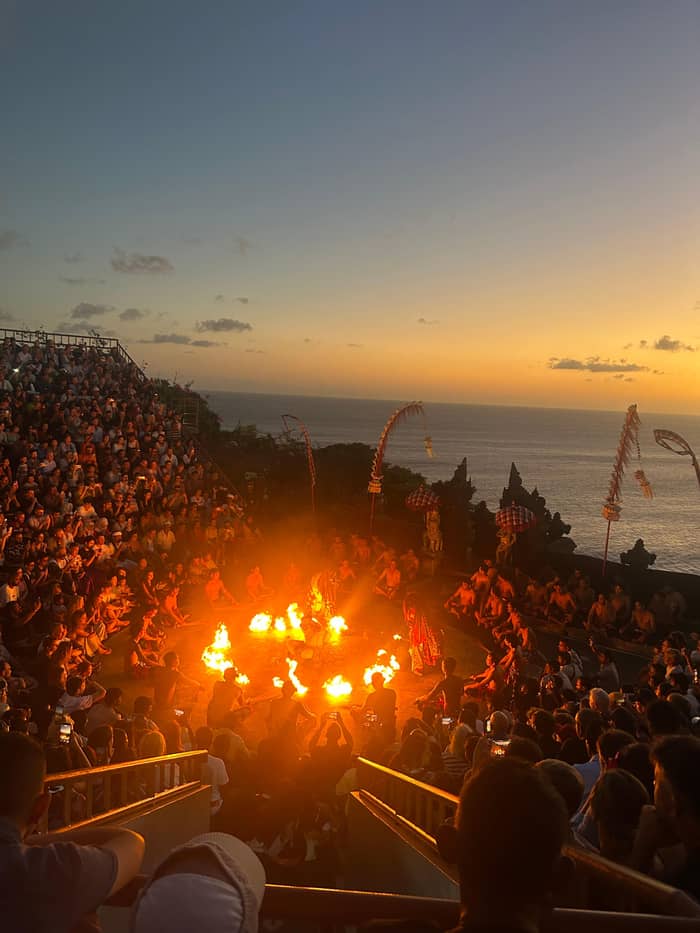
Staged outdoors at dusk, usually on a sea-facing cliff, the Kecak starts in daylight and carries on after dark by the glow of flickering bamboo torches.22 At Uluwatu the amphitheater stands 70 meters above the Indian Ocean.49
Each day the gate opens at 16:00 and the stage is busy from 18:00 to 19:00.4 It also says 6:00 PM is the show time, and arriving at 6:00 PM is already too late.24 Arriving early does not guarantee one specific seat, but it gives time to follow the seating process calmly.50
Fit the story into the evening: the early scenes play in the last light and the fire scene in the dark. If you want company, one listing on this site sells a ticket with three options, from the show alone to a temple tour with the sunset show, from $9.
FAQ
For the Ministry of Tourism the male chorus plays an army of monkeys.19
The story is conveyed through facial expressions, movements and rhythmic sounds, with no spoken dialogue.42
The Uluwatu management credits Wayan Limbak and Walter Spies with developing the Kecak in the 1930s.35
Balinese tradition holds that the cak sound chases off evil spirits and carries protective power.27
The Ministry describes concentric circles of about 50 to 60 bare-chested men sitting around torches.17
The management says the Kecak uses no musical instruments, only the chanting of a large male chorus.3
The temple says you do not need to know every detail of the epic to follow the performance.10
Sources
Keep reading
Questions about the Kecak show or the temple? A person answers here.